

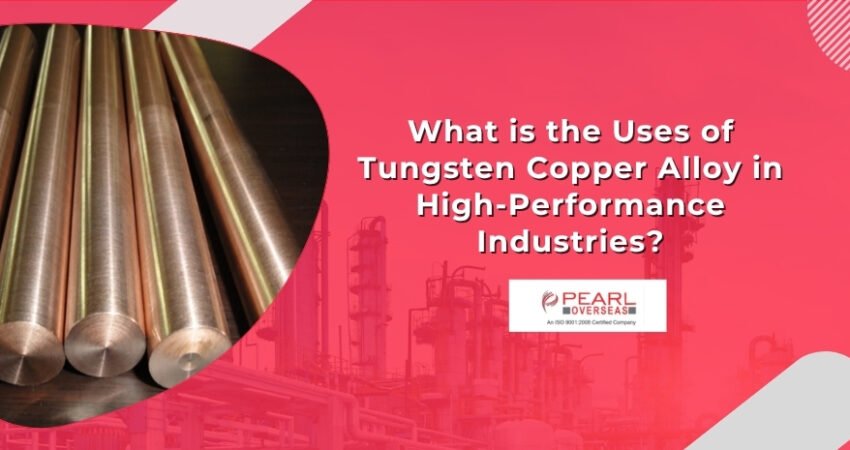
What Is Tungsten Copper (W-Cu)?
Tungsten copper alloy, also written W-Cu or copper tungsten, combines the high melting point, hardness, and arc resistance of tungsten with the electrical and thermal conductivity of copper. Strictly speaking it is a composite rather than a true alloy, because tungsten and copper do not dissolve in each other. Copper fills the pores of a sintered tungsten network, giving a dual-phase material that behaves differently from either metal alone.
Quick answer: the main uses of tungsten copper alloy are electrical contacts for high-voltage switchgear, resistance welding and EDM electrodes, heat sinks and heat spreaders for electronics, and heat-resistant aerospace parts such as rocket nozzle inserts.
Tungsten Copper Properties by Grade
Grades are named by their weight percentage of tungsten and copper, for example W80Cu20 (80% tungsten, 20% copper). The table below shows typical values for the common grades. Exact figures vary by supplier and process, so confirm them against the datasheet for your order.
| Grade | Tungsten / Copper (wt%) | Typical Density (g/cm³) | Electrical Conductivity (% IACS) | Hardness (HB) |
|---|---|---|---|---|
| W90Cu10 | 90 / 10 | 16.75 | 27 | 260 |
| W85Cu15 | 85 / 15 | 15.90 | 30 | 240 |
| W80Cu20 | 80 / 20 | 15.15 | 34 | 220 |
| W75Cu25 | 75 / 25 | 14.50 | 38 | 195 |
| W70Cu30 | 70 / 30 | 13.80 | 42 | 175 |
How Composition Changes Performance
- More tungsten: higher density and hardness, better resistance to arc erosion, and lower thermal expansion.
- More copper: higher electrical and thermal conductivity, as the table shows.
- Thermal expansion: tungsten expands about 4.5 × 10⁻⁶/K and copper about 17 × 10-6/K. W-Cu falls in between, depending on the grade, which is why it can be matched to semiconductors and ceramics.
W-Cu is usually made by powder metallurgy: a porous tungsten skeleton is sintered and then infiltrated with molten copper.
Main Uses of Tungsten Copper Alloy
1. Electrical Contacts and Arcing Parts
One of the biggest uses of tungsten copper is in arcing contacts for medium- and high-voltage circuit breakers, vacuum interrupters, and SF6 switchgear. The tungsten phase resists erosion from repeated electrical arcs, while copper carries current and conducts heat away. In air, grades with more copper generally erode less.
2. Resistance Welding Electrodes
W-Cu electrodes are used in resistance welding where standard copper alloys wear too quickly, for example in projection welding. Their hardness, high-temperature resistance, and conductivity extend electrode life. For general spot welding, copper-chromium-zirconium is the usual lower-cost choice; see our copper chromium zirconium products.
3. EDM Electrodes
Electrical discharge machining (EDM) erodes metal with controlled sparks, so the electrode must resist spark erosion while conducting current well. Tungsten copper EDM electrodes hold their shape and cut hard materials such as tool steels and carbides, which is useful in mold, die, and precision tooling work.
4. Heat Sinks and Heat Spreaders for Electronics
In power semiconductor modules, RF and microwave packages, and similar electronics, tungsten copper heat sinks remove heat while expanding at a rate close to the chip and ceramic substrate. This reduces stress on joints during heating and cooling. Higher-tungsten grades such as W90Cu10 and W85Cu15 are commonly chosen when low expansion matters most.
5. Aerospace and High-Temperature Parts
Tungsten copper is used for rocket nozzle inserts, gas rudders, and similar parts exposed to extreme heat and erosion. At very high temperature, the copper phase can melt and vaporize, absorbing heat and cooling the surface, an effect often called transpiration or sweat cooling. This is a designed use of the material, and it is one reason W-Cu is selected for short, intense thermal loads.
Which Grade for Which Application?
Grade selection depends on the duty. The ranges below are common starting points, so confirm with your supplier or design engineer.
| Application | Commonly Used Grades | Why |
|---|---|---|
| Arcing contacts, switchgear | W70Cu30 to W80Cu20 | Balance of arc erosion resistance and conductivity |
| Resistance welding electrodes | W70Cu30 to W80Cu20 | Hardness with good conductivity |
| EDM electrodes | W70Cu30 to W80Cu20 | Spark erosion resistance, conductivity |
| Heat sinks, heat spreaders | W80Cu20 to W90Cu10 | Low thermal expansion, high thermal conductivity |
| Rocket nozzle inserts | High-tungsten grades, per design | Heat and erosion resistance |
Tungsten Copper vs Other Materials
| Material | Density | Best For |
|---|---|---|
| Tungsten copper (W-Cu) | About 13.8-16.75 g/cm³ | Arc resistance, conductivity, and low expansion together |
| Molybdenum copper (Mo-Cu) | About 10 g/cm³ | Heat spreaders where lower weight matters |
| Tungsten heavy alloy (W-Ni-Fe/Cu) | About 17-18.5 g/cm³ | Counterweights and radiation shielding, not conductivity |
| Copper chromium zirconium (CuCrZr) | About 8.9 g/cm³ | Standard welding electrodes, high conductivity at lower cost |
For the heavy alloy grades, see our tungsten heavy alloy page.
Limits and Design Notes
- Copper limits the temperature: copper melts at about 1,083 °C, so W-Cu is not a structural material for sustained heat above that unless the cooling effect is part of the design.
- Oxidation: in air at high temperature, both metals oxidize, so W-Cu performs best in oil, SF6, vacuum, or short-duration conditions.
- Conductivity is lower than pure copper: even W70Cu30 reaches about 42% IACS, so it is chosen for the combination of properties, not for conductivity alone.
Buying Tungsten Copper: What to Specify
- Grade: the tungsten and copper percentages, such as W80Cu20.
- Key properties: minimum density, electrical conductivity (% IACS), and hardness.
- Form and size: tungsten copper round bar, plate, or machined parts, with tolerances.
- Certification: a test certificate showing the properties of the lot you receive.
Browse our full range of tungsten copper products.
Conclusion
The uses of tungsten copper alloy follow directly from its mix of properties: arc resistance and hardness from tungsten, and conductivity from copper. That makes it a standard material for high-voltage contacts, welding and EDM electrodes, electronic heat sinks, and aerospace parts. Choosing the right grade, and understanding that more tungsten means higher density and lower expansion while more copper means higher conductivity, is the key to specifying it well.
FAQs
Q1. What are the main uses of tungsten copper alloy?
The main uses are arcing contacts in high-voltage switchgear and vacuum interrupters, resistance welding electrodes, EDM electrodes, heat sinks and heat spreaders for electronics, and heat-resistant aerospace parts such as rocket nozzle inserts.
Q2. Is tungsten copper a true alloy?
No. Tungsten and copper do not dissolve in each other, so W-Cu is a composite in which copper fills the pores of a tungsten skeleton. It is still commonly called tungsten copper alloy.
Q3. Why is tungsten copper used for EDM electrodes?
It resists spark erosion, conducts current well, and keeps its shape under intense local heat, which supports precise machining and long electrode life.
Q4. Why is tungsten copper used in heat sinks?
It conducts heat well and has a thermal expansion much lower than copper, so it can be matched to semiconductor chips and ceramic substrates, reducing stress during temperature changes.
Q5. What is the density and conductivity of W80Cu20?
Typical values for W80Cu20 are a density of about 15.15 g/cm³ and an electrical conductivity of about 34% IACS. Exact values vary by supplier and process.
Q6. Is tungsten copper used in the aerospace industry?
Yes. It is used for rocket nozzle inserts and gas rudders. At very high temperature the copper can vaporize and cool the surface, which helps the part survive short, intense heat loads.
Need tungsten copper in a specific grade or size? Contact us or email export@pearlshims.com with your grade, dimensions, and quantity for a quote.