

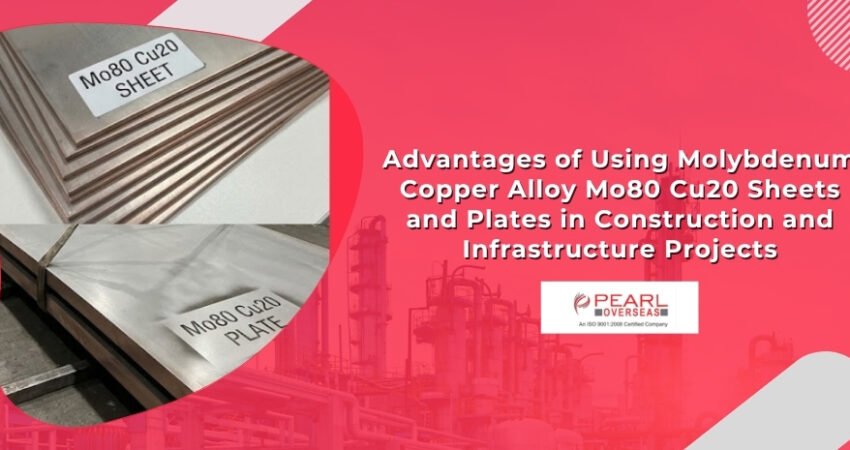
Advantages of Using Molybdenum Copper Alloy Mo80 Cu20 Sheets and Plates in Construction and Infrastructure Projects
Why Mo80 Cu20 Matters for Heavy-Duty Infrastructure Equipment?
Many components for large-scale infrastructure, power stations, substations, heavy fabrication yards and industrial plants require repeated heating and cooling without warping or cracking. Molybdenum Copper Alloy Mo80 Cu20 Sheets Plates were designed for that purpose. The material is used in a number of different proportions, and one of the most widely specified grades is 80:20, which is a balance of molybdenum’s resistance to high temperature and copper’s high heat and electrical conductivity. This alloy is always specified by name by engineers and procurement personnel involved in electrical switchgear and industrial furnace systems when they want their system to maintain its form more easily than that of generic steel or plain copper systems under the same thermal load. The post explains what the alloy is, where it makes life easier in infrastructure projects, and some things buyers should know before ordering it.
Key Takeaways
- Mo80 Cu20 blends molybdenum’s low thermal expansion coefficient with copper’s high conductivity to withstand warping during multiple heat cycles.
- It is found primarily on infrastructure projects as heat sinks, electrical contacts, welding electrodes, and tooling in the vicinity of furnaces, not as a bearing or structural material.
- The CTE can be matched with ceramics and ceramic-based insulators, which is relevant to switchgear and high-power electrical equipment in the grid infrastructure.
- Powder metallurgy supplies sheets and plates, so be sure to check the density, thickness tolerance, surface finish and actual duty cycle with the buyer before placing an order.
What Molybdenum Copper Alloy Mo80 Cu20 Actually Is?
Mo80 Cu20 is not a melted alloy, but a powder-metallurgy composite. The molybdenum powder is pressed and sintered into a porous skeleton, followed by infiltration with copper to create a product, usually in the form of a molybdenum sheet or plate, that is approximately 80% molybdenum and 20% copper. That process also endows the material with a coefficient of thermal expansion between the two parent metals, which can be further modified by adjusting the copper content, and a thermal conductivity of 180-250 W/cmK (recent industry data) at room temperature and a strength of over 300 MPa. In practice, this means that the sheet swells and contracts slightly with changes in temperature, but conducts heat and current significantly better than molybdenum alone.
Molybdenum Copper Alloy in Construction and Industrial Infrastructure
Being specific about the applications of this alloy is helpful. It is not a structural beam or rebar substitute, and describing it that way would overstate its role. Its true worth on construction and infrastructure sites is reflected in the equipment that keeps them running:
- Electrical substations and switchgear: Mo80 Cu20 contacts and terminals switch repeatedly without being melted or distorted by the arc heat.
- Heavy fabrication and welding operations: Water-cooled electrode heads and resistance-welding tooling require use of the alloy since it can endure thousands of heat cycles at the weld point.
- Industrial furnaces tied to plant infrastructure: Cement, steel, and glass plants use Mo-Cu components in furnace fixtures where dimensional drift would misalign the whole assembly.
- Power and telecom infrastructure hardware: High-power inverters, transmission equipment, and base station hardware use Mo-Cu heat spreaders to keep electronics within a safe operating temperature.
Mo80 Cu20 Sheets Plates: Where the Sheet and Plate Form Factor Fits
Sheets and plates are the practical form for anything that requires a flat, heat distributed over a wide area and needs to be machinable. In an infrastructure project, that usually refers to a heat sink or mounting plate that is directly under a power module, a busbar contact plate or a baseplate cast into a particular switchgear housing bracket shape. As the molybdenum content remains at or below approximately 75-80%, the material is reasonably good to cut with machines and stamps, which helps keep fabricators from using exotic tooling, and this helps to maintain lead times on multi-site rollouts.
Thermal Expansion Matching Matters More Than It Looks
A large share of the alloy’s value comes down to one number: coefficient of thermal expansion (CTE). The CTE window of ceramic insulators, semiconductor substrates, and some composite housings employed in electrical infrastructure equipment is small, and mismatched materials will crack at the bond line on the first occasion of equipment heating up. The Mo-Cu grades range from Mo60Cu40 to Mo85Cu15, where the CTE is in the range of approximately 5.6 x 10⁻⁶/K to 11.5 x 10⁻⁶/K, and is within the range of commonly used ceramic and semiconductor packaging materials. Mo80 Cu20 sits toward the lower-expansion end of that band, closer to molybdenum’s own behaviour, which is why it gets specified where dimensional stability is the priority over raw conductivity.
Mo80 Cu20 vs. Other Heat-Management Materials
| Property | Mo80 Cu20 | Pure Copper | Tungsten Copper (W-Cu) |
| Thermal conductivity | ~180-250 W/(m·K) | ~390-400 W/(m·K) | Comparable to Mo-Cu |
| CTE tunability | Yes, by composition | Fixed, high (~17 ppm/K) | Yes, by composition |
| Density | Moderate | Moderate | High |
| Best fit | Dimensional stability with good heat transfer | Maximum conductivity, less CTE control | Weight-tolerant, similar performance to Mo-Cu |
For a deeper look at how composition changes these numbers, see how alloying affects the properties of molybdenum plates.
Raw conductivity is still copper’s strong suit, but its unreachable coefficient of expansion precludes its use anywhere it must join a ceramic or semiconductor interface. Tungsten copper is available in comparable performance to Mo-Cu, but is heavier and is generally used when weight is not a factor. For most grid and industrial infrastructure hardware, Mo80 Cu20 is the practical middle ground.
Procurement Considerations for Mo80 Cu20 Sheets and Plates
Procurement teams should check with the supplier a few points before placing a Purchase Order, before assuming that a standard spec applies:
- Density and porosity: powder-metallurgy sheets can vary in density (commonly cited around 9.5 to 10 g/cc for this grade); ask for a mill certificate.
- Thickness range and tolerance: Mo80 Cu20 sheet is available in a range of approximately 0.5 mm up to 20 mm, ensuring the tolerance is the same as that specified in the assembly drawing.
- Surface finish and plating: some applications may require a nickel or gold-plated surface for solderability; ensure that this is available before cutting the order.
- Certification: for regulated infrastructure work, question the supplier about their ISO 9001 or similar quality system.
For broader context on supply and pricing trends, see our post on understanding molybdenum market trends.
Conclusion
Molybdenum Copper Alloy Mo80 Cu20 Sheets Plates fit into a very specific but common need: to maintain the dimensional stability of electrical and thermal components when they are subjected to repeated heat cycles, while preserving their electrical and thermal conductivity. The CTE is tunable, and the compatibility of the alloy’s expansion with that of ceramics and semiconductor packaging is responsible for its many appearances in substations, welding equipment, furnace fixtures and power infrastructure hardware. It’s not a replacement for structural steel, but for electrical and thermal elements housed within that structural steel, it may make a more consistent long-term decision. Buyers who know and ensure their density, tolerance and certification in advance are less likely to experience fit and finish issues when thinking of this as an off-the-shelf commodity metal.
FAQs
Q1. What is the typical thickness range for Mo80 Cu20 sheets and plates?
Molybdenum Copper Alloy Mo80 Cu20 sheets and plates are available in a range of approximately 0.5 mm up to 20 mm, ensuring the tolerance is the same as that specified in the assembly drawing.
Q2. Is Mo80 Cu20 suitable for high-power electrical applications?
Yes, Mo80 Cu20 is widely used in high-power electrical applications such as electrical substations and switchgear due to its excellent thermal and electrical conductivity, as well as its ability to withstand repeated heat cycles without failure.
Q3. Can Mo80 Cu20 sheets and plates be plated with other metals?
Yes, some applications may require a nickel or gold-plated surface for solderability; ensure that this is available before cutting the order.
If your project spec calls for Molybdenum Copper Alloy Mo80 Cu20 Sheets Plates, share your thickness, tolerance, and finish requirements with our technical team for a mill-certified quote and lead time. You can also browse our full molybdenum products range to see related sheet, plate, rod, and disc options.