

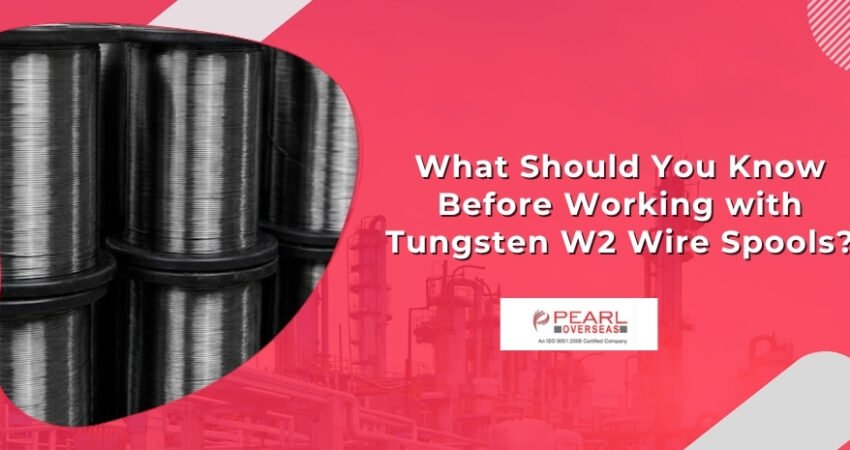
What Should You Know Before Working with Tungsten W2 Wire Spools?
Why Tungsten W2 Wire Deserves a Closer Look Before You Order
If you are sourcing wire for a heating element, a lighting filament, or a precision electrical contact, chances are you have come across Tungsten W2 Wire Spools somewhere in your search, possibly while comparing it against a standard molybdenum wire option for the same job. This particular grade of tungsten wire is doped with a small percentage of thoria or a similar oxide, which changes how the wire behaves under heat and stress compared to plain, undoped tungsten. It is important to know what W2 actually is, what it does best, and to know what to look for before it arrives on your workbench. Getting this right the first time saves rework, wasted material, and shop-floor delays, especially when the wire goes into a high-value assembly that cannot afford a second attempt.
W2 Tungsten Properties That Actually Matter
The “W2” designation is for a doped tungsten wire containing approximately 1 to 2 percent thorium oxide, which is a form of thorium, as a dopant in the base tungsten. The small increment has a huge impact on performance. Compared to pure tungsten wire, W2 tungsten properties include:
- Better resistance to grain growth at very high operating temperatures
- Improved electron emission, which matters for filaments and cathodes
- Slightly easier machinability and handling during coiling
- More stable mechanical strength after repeated heating and cooling cycles
Tungsten, by itself, has one of the highest melting points of all metals, and the addition of thoria further increases that stability. That is why manufacturers of incandescent filaments, vacuum tube components, and some welding electrodes prefer to use the lower-grade W2. If you’re using it for a long period of time (not a quick temperature spike), W2 generally offers better conductivity and shape retention.
Common Tungsten Wire Applications
Before you choose your spool size or diameter, you should plot your use case against the use of this wire in the industry. Typical applications of tungsten wire are grouped into a few common areas:
- Lighting and filaments – incandescent bulbs, halogen lamps, and speciality lighting continue to use tungsten wire for its ability to maintain a consistent glow when cycled on and off.
- Electronics and vacuum devices – cathodes, grids, and heating elements inside vacuum tubes and X-ray equipment, a category that overlaps with how tungsten rods are used in semiconductor manufacturing.
- Welding electrodes – thoriated tungsten in TIG welding, famous for the capability to maintain a steady arc.
- Thermal and furnace elements – heating coils in a high-temperature furnace that must withstand thousands of heating cycles without sagging.
- Precision springs and probes – Precision fine gauge wire for test probes and micro-springs, where stiffness and dimensional accuracy are critical.
Each of these tungsten wire applications has slightly different spool requirements, whether it is diameter tolerance, surface finish, or coil tension; be specific with your supplier rather than ordering a generic size.
Diameter, Purity, and Spool Handling
Wire spools are usually sold by diameter (measured in millimetres or thousandths of an inch), spool weight, and coil tension. Some helpful tips to remember:
- Thinner gauges tend to kink as they are unspooled, so review the package material on the spool and the core diameter before ordering large quantities.
- Ask your supplier for a certificate of composition confirming the thoria content, since W2 grades can vary slightly between batches.
- Store spools in a dry, contamination-free area, as tungsten wire can pick up surface oxidation if left exposed for long periods.
- When you’re unsure of the correct wire length for a production run, a tungsten weight chart is a handy reference for converting length and diameter to weight, helping you avoid over-ordering or running low mid-batch.
| Wire Diameter Range | Typical Use Case | Handling Note |
| 0.05 mm – 0.15 mm | Fine probes, micro-springs | Handle with anti-static gloves; avoid kinks |
| 0.2 mm – 0.5 mm | Filaments, heating elements | Check coil tension before winding |
| 0.5 mm – 2 mm+ | Electrodes, structural wire | Verify straightness and surface finish |
Choosing Reliable Tungsten Suppliers
Not all suppliers carry W2 grade wire, and some provide wire that is a blend and improperly labelled as doped tungsten. When evaluating tungsten suppliers, it is worth asking for:
- Batch-level material certification, not just a generic data sheet
- Consistent diameter tolerance across the full spool length
- Experience supplying industries similar to yours, whether that is lighting, welding, or electronics
- Documentation on thoria content, as the safety handling for thoriated tungsten is slightly different from plain tungsten
Suppliers with a track record in related tungsten and molybdenum products, including composite lines like tungsten copper, often have tighter quality control simply because they work across multiple high-temperature metal categories and understand the tolerances that matter. It is also important to examine a supplier’s approach to safety questions about tungsten alloys; handling practices and health concerns about doped wire may be legitimate concerns that deserve understanding before bulk procurement.
Conclusion
Tungsten W2 Wire Spools are not a one-size-fits-all product. The thoria doping that marks the W2 grade provides benefits in electron emission and thermal stability, making it a good choice for filaments, welding electrodes, vacuum components, and high-temperature furnace elements. Proper performance requires the right wire diameter for the application, appropriate tungsten characteristics through W2 tungsten certification, and tungsten suppliers who can support tungsten claims with documentation. Taking these steps before you order saves both material cost and production downtime later.
FAQs
Q1. What is W2 tungsten wire used for?
W2 tungsten wire is commonly used in incandescent and halogen filaments, TIG welding electrodes, vacuum tube cathodes, and high-temperature furnace heating elements because of its improved thermal stability compared to plain tungsten.
Q2. How is tungsten W2 wire different from pure tungsten wire?
W2 wire contains a small percentage of thorium oxide doping, which improves grain stability at high temperatures and electron emission, while pure tungsten wire lacks this doping and can be more prone to grain growth under sustained heat.
Q3. How do I know how much tungsten wire I need for my project?
Diameter and length determine weight, so using a reference weight chart based on the wire’s diameter helps calculate the exact spool length needed without over-ordering.
If you are still deciding on diameter, purity, or spool size for your next order, our team can walk you through the specification sheet and match it to your application before you commit to a quantity. Reach out with your project details, and we will help you avoid the common sourcing mistakes that lead to wasted wire or delayed production.