

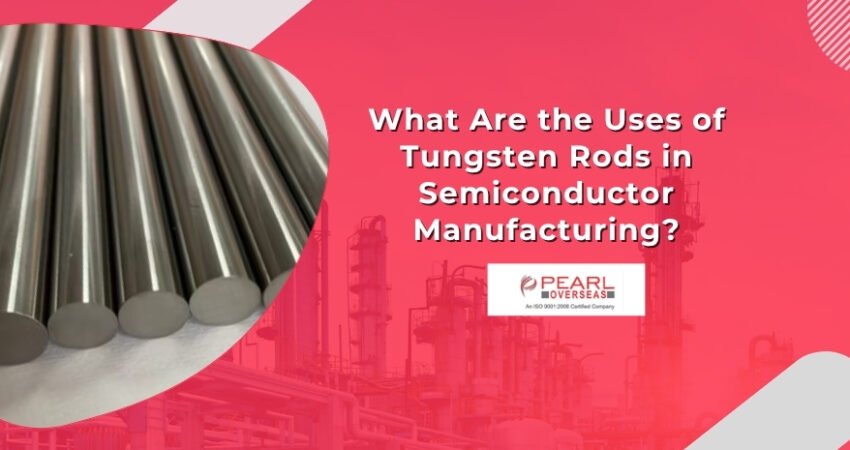
Understanding the Role of Tungsten Rods in Semiconductor Manufacturing
When people ask what are the Uses of Tungsten Rods in Semiconductor Manufacturing, the response is much more than one. Tungsten rods have a silent, but very important part to play in the backbone of modern electronics. Electric vehicles and sophisticated automation systems aside, semiconductor devices are becoming dependent on a material capable of operating in high temperatures, high electrical applications, and high-precision manufacturing areas. Tungsten is a near-perfect fit to this requirement.
In semiconductor production, the materials are subjected to high temperatures, a vacuum environment and harsh chemical treatment. Tungsten rod is appreciated due to its very high melting point, high thermal stability, low vapour pressures and consistent electrical conductivity. These characteristics render them essential in wafer fabrication, deposition processes, and equipment components in which performance consistency cannot be compromised. To decision-makers, including construction heads, architects, and contractors working in large-scale industrial projects or other high-tech facilities, the interpretation of how tungsten rods contribute to the semiconductor manufacturing process can assist people in valuing their significance in the modern infrastructure and the technology-driven industries.
Why Tungsten Rods Matter in Semiconductor Manufacturing Processes?
The rods of tungsten are selected not randomly. They are distinctive in terms of their physical and chemical properties that enable them to be used in semiconductor environments.
Key reasons tungsten rods are widely used include:
- Very high melting point (more than 3,400 °C)
- Exceptional thermal deformation properties.
- Constant functioning under high vacuum.
- Electrical conductivity Good.
- Fabrication risk is low for contamination.
Such benefits guarantee extended life, as well as the reliability of the process that is vital in semiconductor plants, where downtime can be highly expensive.
Use of Tungsten Rods in Chemical Vapour Deposition
Tungsten Rods for Thin Film Deposition
Tungsten rods are one of the most commonly used elements in semiconductor manufacturing, in Chemical Vapour Deposition (CVD) systems. Tungsten is usually deposited in the form of a thin film to create interconnects in integrated circuits.
In this process:
- The Tungsten rods are used either as a heating element or as a structural element.
- They assist in the control of consistent temperature in deposition.
- Even distribution of heat ensures a high quality and consistency of the film.
The thin films of tungsten have been chosen on the basis of their low electrical resistance and high reliability in highly dense semiconductor circuits.
Tungsten Rods in Etching and Wafer Processing Equipment
Supporting Precision and Durability
Etching is a sensitive process in the semiconductor production industry in which a good level of accuracy of material removal is necessary. The Tungsten rods are commonly utilized in:
- Plasma etching chambers
- Ion implantation systems
- Wafer handling mechanisms
Long production cycles. Dimensional stability is guaranteed by them due to their resistance to both chemical corrosion and plasma erosion. This is what makes tungsten rods suitable for precision equipment, when even slight wear can be of importance in terms of the performance of the chips.
Role of Tungsten Rods in Electrical Contacts and Interconnects
Enhancing Conductivity and Reliability
The other significant use is in the answers to the question: What are the applications of tungsten rods in semiconductor manufacturing? electrical interconnects.
Tungsten is widely used for:
- Transistor-to-transistor contact plugs.
- Integrated circuit vertical interconnects.
- High-current contact points
Since tungsten can be used in applications where high temperatures are required, it can be utilized to prevent electro migration, which is a typical failure mode in semiconductor products.
Tungsten Rods in High-Temperature Furnace Components
Stability Under Extreme Conditions
The manufacturing of semiconductors is usually accompanied by furnaces that are of high temperature and that are used in the diffusion and annealing. Tungsten rods are used as:
- Structural supports
- Heating elements
- Fixture components
They can undergo repeated thermal cycles without being distorted, hence they are perfect for continuous industrial processes. This consistency is especially essential in large production plants of fabrics used on a large scale.
Benefits of Tungsten Rods for Semiconductor Manufacturing Facilities
To the leaders in industries and project planners, tungsten rods have many practical advantages:
- Lower wear resistance reduces the maintenance.
- Extensive service in adverse conditions.
- Better yield and accuracy of the process.
- Lower risk of contamination.
All of these advantages can be translated into cost efficiency and high throughput that is paramount to giant semiconductor manufacturing facilities.
Conclusion
Finally, when considering the applications of tungsten rods in semiconductor technology, one can see that they play a crucial role in the current technology. Throughout the entire process of semiconductor manufacture, tungsten rods are used in thin film deposition and wafer processing, electrical interconnect, and components in high temperature furnaces. They are unparalleled in terms of thermal stability and durability and cannot be replaced by other substitutes due to their unmatched electrical performance in an industry where precision and reliability are the hallmarks of success. The tungsten rods will still be on the list of materials the industry will rely on to innovate and scale as the demands of semiconductors continue to rise in the construction, infrastructure, and smart technologies.
FAQs
Q1. Why are tungsten rods used in making semiconductors, as opposed to other metals?
Tungsten rods are favored because they have a high melting point, low vapor pressure and can withstand thermal and chemical stress and are hence suitable in high precision semiconductor processes.
Q2. What are the applications of the tungsten rods in the fabrication of a wafer?
Tungsten rods are found in wafer fabrication, in deposition systems, in etching equipment and in the furnace component, so that it provides consistency in performance and correct processing.
Q3. Do semiconductor nodes of the advanced nodes utilize tungsten rods?
Yes, the tungsten rods are common in the advanced semiconductor nodes since tungsten interconnects provide stable conductivity with lesser electro migration in the smaller geometries.
Looking to source high-quality materials for advanced manufacturing projects?
Ready to grow your visibility and upgrade your material solutions? Explore reliable tungsten rods for semiconductor manufacturing and industrial applications today.
Contact us or email us at export@pearlshims.com to discuss your requirements and connect with trusted suppliers.