
All You Need to Know About Tungsten Rods for TIG Welding
Why Does the Right Tungsten Rod Decide Weld Quality?
Each TIG weld requires a thin tungsten rod that won’t melt into the joint. It just carries the arc. However, a bad match shows up early: a wandering arc, tungsten specks in the weld pool, or a tip that needs regrinding every few minutes. For teams welding stainless tubing, titanium, or nickel alloys in aerospace, medical, and chemical plants, those flaws cost real money.
This is a simple explanation of tungsten rods for TIG welding. It covers the main tungsten electrode types, the color codes, and how to match tungsten electrode size and tip shape to your job. Use it as a quick reference before going on your next purchase order.
Key Takeaways
- Tungsten rods are non-consumable. Their oxide additions determine arc readiness and tip life.
- Lanthanated and ceriated grades have largely replaced thoriated rods because they are not radioactive.
- Select by base metal, current type, and amperage, then match diameter and the tip shape.
What Tungsten Rods Do in a TIG Arc?
Tungsten has the highest melting point of any metal, about 3,422°C. That’s why it can retain an arc for hours without joining into the weld. Filler metal is added separately. Trade talk is “tungsten rod,” and standard talk is “tungsten electrode. Both describe the same part.
Pure tungsten is sensitive to starting, so manufacturers add small quantities of oxides. These additives help electrons leave the tip, making starting easier, the arc more stable, and wear slower. If you also buy tungsten in other forms, our guide to tungsten W2 wire spools will help you know what to look for before ordering.
Tungsten Electrode Types and Color Codes
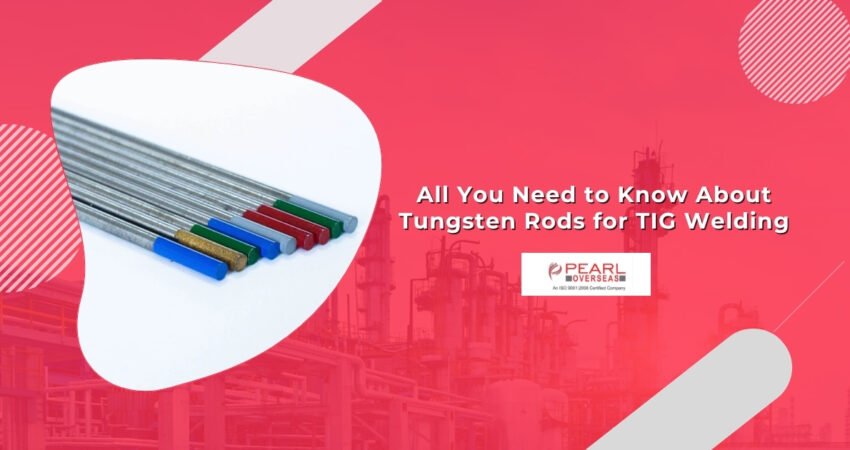
AWS A5.12, currently published as A5.12M/A5.12:2024, is based on ISO 6848 and assigns each grade a class and a color band. The composition ranges below follow the Fabricator’s electrode guide and supplier charts.
| Type | AWS class | Color | Oxide additive | Typical use |
| Pure | EWP | Green | None | AC welding of aluminium and magnesium on older machines |
| Thoriated | EWTh-2 | Red | 1.7 to 2.2% thorium oxide | Legacy DC work on steel and stainless |
| Ceriated | EWCe-2 | Grey | 1.8 to 2.2% cerium oxide | Low-amp DC, thin sections, orbital work |
| Lanthanated | EWLa-1.5 | Gold | 1.3 to 1.7% lanthanum oxide | General purpose, AC and DC |
| Zirconiated | EWZr-1 | White | 0.15 to 0.40% zirconium oxide | AC welding only |
Treat the band as a quick check, not proof. Older stock had different colors (ceriated rods were orange, for example), so check the classification on the rod or box.
Thoriated vs Lanthanated Tungsten: Which Should You Choose?
Thoriated rods made their name in DC applications on steel and stainless. They start easily and last well. The drawback is thorium oxide, which is radioactive, so grinding dust needs strict control. Many shops now avoid it altogether.
Usually replaced by lanthanated tungsten. It is clean-cut and runs on both AC and DC; therefore, it can be used for aluminium, stainless, and nickel alloys. Ceriated rods work well for low DC amperages on thin tube and sheet, but they fall short at higher currents. Our ceriated tungsten electrode guide delves deeper into that grade.
When it comes to thoriated vs. lanthanated tungsten, procurement teams often prefer lanthanated stock. It simplifies storage and takes thorium handling off the safety checklist.
How to Choose the Right Tungsten Rods for TIG Welding?
Two questions narrow the field fast: what are you going to weld, and what current are you using?
Match the Rod to the Base Metal
- Steel, stainless, titanium, nickel, and copper alloys (DC): lanthanated or ceriated.
- Aluminium and magnesium (AC): lanthanated or zirconiated, or pure tungsten on older machines.
- Zirconiated rods: AC only. They are not suited to DC.
Pick the Right Tungsten Electrode Size
Diameter should follow amperage. A rod that’s too thin will overheat and release tungsten into the weld. One that is too thick starts poorly and wanders at low current. Also, the right tungsten size depends on the machine, so verify the current range your supplier provides for each diameter.
Common sizes run from 1.0 mm to 4.0 mm (0.040 to 5/32 in). A 2.4 mm (3/32 in) rod is a flexible option for use in general fabrication.
How to Sharpen Tungsten for TIG Welding?
Preparation matters as much as grade, and sharpening tungsten for TIG welding takes only a few minutes. A few habits help:
- Grind lengthwise with the marks going toward the tip.
- Keep a dedicated wheel for tungsten to avoid contamination.
- Aim for a taper of roughly 2 to 2.5 times the rod diameter for DC.
- Leave a tiny flat on the tip when running higher current.
Continue to shield gas flow after the arc is extinguished to cool the hot tip without oxidation. If the rod touches the pool, regrind the rod before continuing.
Grinding generates dust; use local extraction and a respirator. Our article on whether tungsten alloy metals are toxic explains the exposure risks in more detail.
Conclusion
We covered what tungsten rods do in the arc, the main tungsten electrode types and their color codes, how thoriated vs lanthanated tungsten compare, how to pick the tungsten electrode size, and how to sharpen tungsten for TIG welding. In short, choose tungsten rods for TIG welding by base metal and current first, then match diameter and tip shape. Lanthanated electrodes suit most shops, ceriated electrodes suit low-amp thin work, and zirconiated electrodes suit AC.
FAQs
Q1. What is the best tungsten rod for TIG welding stainless steel?
Lanthanated (EWLa-1.5 or EWLa-2) is a reliable all-round choice on DC. Ceriated (EWCe-2) works well for thin stainless at low amperage. Thoriated also performs well, but its radioactivity makes the alternatives preferable.
Q2. Can one tungsten rod handle both AC and DC welding?
Lanthanated rods can. Ceriated rods run best on DC but can be used on AC. Pure and zirconiated rods are meant for AC only.
Q3. When should I regrind or replace a tungsten rod?
Regrind when the tip is contaminated, the arc wanders, or the rod contacts the weld pool. Change when out of reach or too short to hold and grind.
Looking for tungsten, molybdenum, or other high-temperature alloy products for your industrial application? Please reach out to Molybdenum Products via the contact page or email export@pearlshims.com.